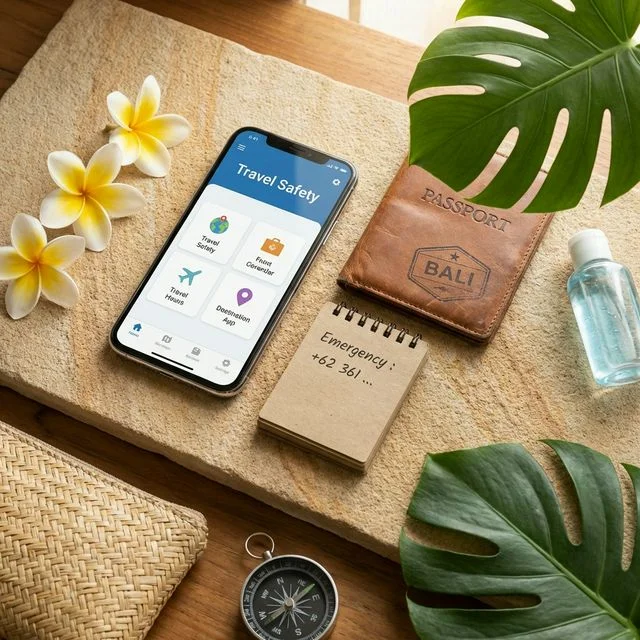
Bali’s general emergency number is 112. For police assistance, call 110; for medical emergencies or an ambulance, 119; and for fire services, 113. These are Indonesian emergency short codes, so dial them directly without adding +62.
Save the numbers before your trip. More importantly, know what to do if a call doesn’t connect, you’re injured somewhere unfamiliar, or you need help communicating in Indonesian.
Need help right now?
Tap a number to call.
Emergency short codes are intended for calls within Indonesia. Service accessibility and response coordination can vary by location or network. If one number doesn’t connect, try the relevant alternative, contact a nearby hospital, or ask someone local to help.
How to Call Emergency Services in Bali
Indonesia doesn’t use 911 as its primary emergency number. The closest equivalent is 112, a general emergency service intended to coordinate assistance from agencies such as police, medical services, and firefighters.
When calling, focus on three things:
- What happened? A traffic collision, medical emergency, fire, or another urgent incident.
- Where are you? Give your accommodation name, street, village, landmark, or GPS coordinates.
- What help do you need? An ambulance, police assistance, or fire and rescue.
Your exact location may be more helpful than a long explanation of the incident.
For example, saying you’re in Ubud is not enough if you’re staying on a narrow road several kilometers outside the center. Open your maps app, find the location pin, and share the coordinates or a nearby landmark.
If you’re at a hotel, restaurant, or villa, ask the staff to call alongside you. A local person may be able to describe the location and communicate with the dispatcher more easily.
What if you don’t speak Indonesian?
You don’t need perfect Indonesian to ask for help. A few simple phrases can make the conversation easier.
| English | Indonesian |
|---|---|
| I need help. | Saya butuh bantuan. |
| Please send an ambulance. | Tolong kirim ambulans. |
| There’s been an accident. | Ada kecelakaan. |
| I need the police. | Saya butuh polisi. |
| My location is… | Lokasi saya di… |
| Someone is injured. | Ada orang terluka. |
| I don’t speak Indonesian. | Saya tidak bisa berbahasa Indonesia. |
| Can you speak English? | Bisa bicara bahasa Inggris? |
Swipe the table sideways to see all English and Indonesian phrases.
An example:
“Tolong kirim ambulans. Ada kecelakaan. Lokasi saya di Jalan Raya Ubud, dekat [landmark].”
Please send an ambulance. There’s been an accident. My location is on Jalan Raya Ubud, near [landmark].
Don’t assume every emergency operator speaks English. If communication becomes difficult, ask your accommodation staff, driver, or someone nearby to help translate.
What if the emergency number doesn’t connect?
Don’t keep redialing one number indefinitely when someone needs urgent help.
Try another relevant emergency line, ask a nearby person to call using an Indonesian mobile network, or contact a hospital directly. If your phone has no signal, move to a safer location where reception is available, if you can do so without putting yourself or the injured person at risk.
A messaging app may also help you reach your accommodation or a trusted contact when a voice call isn’t working, provided you have an internet connection.
Remember that 112 and other short codes are not ordinary international telephone numbers. Don’t turn 112 into +62 112 or 110 into +62 110. Use the +62 country code only for regular Indonesian phone numbers shown in international format.
If you’re using a data-only travel eSIM, such as certain Airalo plans, don’t assume it can make ordinary telephone calls. Check whether your plan supports voice calling, and keep another reliable way to contact emergency services. Our SIM card and internet in Bali guide explains how data-only eSIMs differ from plans with a local number.
What to Do in a Medical Emergency
Getting sick is inconvenient anywhere. Getting seriously ill when you’re traveling alone, without someone who knows your medical history, adds another problem: you may have to make decisions while feeling unwell.
If someone is unconscious, struggling to breathe, bleeding heavily, showing signs of a stroke, or experiencing another potentially life-threatening condition, call 119 for emergency medical assistance. You can also try 112.
Don’t spend precious time comparing hospitals online before requesting urgent care.
For a less immediately dangerous problem, such as a persistent fever or an injury that needs examination, contact a nearby medical facility for advice. Your accommodation may be able to recommend an accessible clinic or arrange suitable transportation.
Can you use Halodoc while traveling in Bali?
For non-emergency health concerns, Halodoc is another option worth knowing.
The Indonesian telemedicine app offers 24-hour access to online doctor consultations, including in-app chats. Depending on the medical assessment and local service availability, you may also be able to order prescribed medication for delivery to your accommodation.
I’ve used Halodoc several times in Jakarta, although I haven’t personally tested its services in Bali.
A note for travelers using Airalo or other data-only eSIMs: Halodoc’s chat service uses an internet connection, so a working data eSIM can provide connectivity once you’re signed in. However, Halodoc requires a phone number and sends account verification codes through SMS or WhatsApp.
Many travel eSIMs provide mobile data without a conventional phone number or SMS service. You may therefore need access to your regular phone number or its registered WhatsApp account to complete verification.
Halodoc’s compatibility with international phone numbers has not been confirmed for every country. If you plan to use it, try creating an account and testing access before arriving in Bali rather than setting everything up for the first time when you’re ill.
Medicine delivery, payment options, doctor availability, and service coverage should also be checked in the app for your specific location. Do not use telemedicine as a substitute for urgent in-person medical care.
If you have a scooter accident
First, get yourself out of immediate traffic danger if you can move safely. Do not move a seriously injured person unless there is an immediate threat, such as approaching traffic or fire.
Then:
- Call 119 if anyone may need emergency medical attention. Call 110 if police assistance is needed.
- Share your exact location, preferably with a GPS pin or nearby landmark.
- Follow the emergency operator’s first-aid instructions.
- If it’s safe, record the location, vehicle details, and any relevant evidence.
- Contact your insurer once urgent medical needs are being addressed.
Do not assume you are uninjured just because you can stand up. Some injuries, including head injuries, may not be immediately obvious.
For serious injuries, avoid transporting the patient on another scooter or arranging an ordinary taxi without medical guidance.
Also, check your travel insurance policy before renting a scooter. A valid license, the appropriate driving entitlement, helmets, and policy exclusions can all affect coverage. Having insurance doesn’t automatically mean every scooter accident is covered.
If you’re sick and alone in your accommodation
Tell the accommodation staff where you are and what symptoms you’re experiencing. If you think your condition may be serious, seek medical help promptly rather than waiting for a friend or relative overseas to reply.
For a non-emergency concern, you could contact a local clinic or use Halodoc for an online doctor consultation if you already have access to the app. This may be particularly convenient if you’re not feeling well enough to visit a clinic for a minor problem.
However, don’t assume medication delivery will be available at every villa or hotel. Check your address in the app, and ask accommodation staff for help arranging a pharmacy or clinic visit if delivery isn’t possible.
Keep your passport or identification, insurance details, medication list, and emergency contact information accessible. If your condition worsens, these details may help the people assisting you.
For non-emergency treatment, ask the clinic or hospital about consultation costs, payment methods, and whether they can communicate with your insurer.
For urgent treatment, don’t delay getting help while waiting for an insurance authorization.
Hospitals and Medical Contacts in Bali
The following hospitals are practical contact points for travelers staying in different parts of Bali. Their published phone numbers were checked against hospital contact pages.
They are not ranked by medical quality, and the nearest suitable emergency department may be different depending on your location and condition.
| Area | Hospital | Contact |
|---|---|---|
| Kuta | BIMC Hospital Kuta | +62 361 761263 |
| Nusa Dua | BIMC Hospital Nusa Dua | +62 361 3000911 |
| Ubud | BIMC Hospital Ubud | +62 361 2091030 |
| Denpasar | Kasih Ibu Hospital Denpasar | +62 361 3003030 |
Swipe the table sideways to reveal all hospital contact numbers.
BIMC publishes separate contact numbers for its Kuta, Nusa Dua, and Ubud facilities. Kasih Ibu lists 24-hour emergency services and provides its central hospital hotline.
If you’re in Amed, Sidemen, Munduk, Lovina, or another area farther from the main tourist centers, don’t assume one of these hospitals is automatically your fastest or safest option.
Call 119 for emergency coordination or ask a local healthcare provider which facility can handle the particular injury or illness. Travel times and medical capabilities vary.
Indonesian Red Cross (PMI Bali)
- Provincial office: +62 361 9583035
- Disaster-response WhatsApp: +62 813 3947 4681
PMI supports humanitarian and disaster-response activities. Its provincial office number is not a replacement for the medical emergency hotline 119.
Police Assistance: Accidents, Theft and Personal Safety
For immediate police assistance, call 110.
Indonesia’s National Police operates this national contact center for reports including accidents, threats, violence, and other public-safety incidents.
You do not need to begin by locating the nearest tourist police post. In an emergency, use the national police number first.
Local police contacts
For situations that require contacting a regional police office directly, the Indonesian National Police publishes the following numbers:
| Police office | Contact |
|---|---|
| Bali Regional Police (Polda Bali) | +62 361 227174 |
| Denpasar Police (Polresta Denpasar) | +62 361 8448902 |
| Gianyar Police (Polres Gianyar) | +62 361 943110 |
Swipe the table sideways to reveal all police office contacts.
These are regional office contacts, not guaranteed alternatives to emergency dispatch.
What if your phone or bag is stolen?
Start with your personal safety. If someone threatens you, don’t put yourself at greater risk trying to recover your belongings.
Once you’re somewhere safe:
- Report the incident to police and ask about obtaining a written report and a Surat Tanda Terima Laporan Polisi (STTLP), which means Police Report Receipt. This is the official acknowledgment that police have received your report, not proof that the incident has already been investigated or resolved.
- Contact your bank or card issuer immediately if payment cards were taken.
- Secure your phone and online accounts remotely if possible.
- Contact your accommodation and travel insurer for assistance.
Keep copies of any police documentation. They may be needed for an insurance claim, replacement documents, or other administrative procedures.
If you’re reporting a lost item rather than a suspected crime, police may issue a different document, such as a Surat Keterangan Tanda Lapor Kehilangan, a certificate acknowledging a reported loss. Ask which document is appropriate for your situation and what your insurer or embassy requires.
What if you lose your passport?
If your passport is lost or stolen, contact your country’s embassy or consulate for advice about replacement or emergency travel documents.
Report a suspected theft to police and ask what documentation your embassy requires. You may also need to contact Indonesian immigration authorities before departure, especially if your immigration records or entry permission need updating.
Don’t assume an embassy can immediately issue a normal passport or that replacement paperwork automatically resolves Indonesian immigration requirements.
Fire and Rescue Services
If you discover a fire, prioritize getting everyone out of immediate danger before attempting anything else.
Call 113 for the fire service or 112 for general emergency assistance.
If you’re staying at a hotel or villa, alert staff and follow the property’s evacuation instructions. Use stairs rather than elevators during a building fire, and don’t return inside for luggage.
For regional assistance, these government contacts are available:
| Area | Service | Contact |
|---|---|---|
| Denpasar | BPBD general emergency response | +62 361 223333 |
| Badung Regency | Badung Fire and Rescue | +62 361 411333 |
Swipe the table sideways to reveal all fire and rescue contacts.
Badung Regency includes major visitor areas such as Kuta, Seminyak, Canggu, Jimbaran, and much of the Bukit Peninsula. These regional numbers can be useful backups, but the national short codes should remain the first reference for visitors.
During floods, storms, or other natural hazards, follow instructions from local authorities and your accommodation. Avoid entering floodwater or crossing damaged roads simply because your accommodation is nearby.
Search and Rescue: BASARNAS 115
If someone goes missing during a hike, a boat encounters a serious incident, or a person needs search-and-rescue assistance, contact BASARNAS on 115.
BASARNAS is Indonesia’s National Search and Rescue Agency (Badan Nasional Pencarian dan Pertolongan), with a regional search-and-rescue office serving Bali.
When reporting an incident, provide the last known location, time of disappearance or accident, number of people involved, and any information that may help rescuers reach them.
Search-and-rescue operations can be complicated by weather, sea conditions, terrain, and distance. Don’t put yourself in danger attempting an improvised rescue.
For a serious maritime incident, ask the boat operator or crew to initiate their established emergency procedures while someone contacts the appropriate rescue authority.
Snake Encounters and Animal Emergencies
You may never need these contacts, but they’re worth knowing if you stay in a villa surrounded by vegetation or encounter injured animals.
If you find a snake
Don’t try to catch, corner, or kill it. Keep your distance, move children and pets away, and avoid disturbing the area.
If possible, keep track of where the snake is from a safe distance. You can then contact a reptile rescue service.
Bali Reptile Rescue
- Rescue contact: +62 821 4638 0270
- Website: Bali Reptile Rescue
This is a specialist reptile rescue organization, not an ambulance service. Response availability and travel coverage may vary.
If someone has been bitten by a snake, seek urgent medical assistance. Keep the person as still as possible and arrange emergency medical care. Do not apply a tight tourniquet, cut the wound, or attempt to suck out venom.
Contacting a snake rescuer must not delay medical treatment.
If you’re bitten or scratched by a dog or monkey
Wash the wound immediately with soap and running water for 15 minutes, then seek medical assessment promptly.
Bali has rabies risks, and even apparently minor bites or scratches can require urgent preventive treatment. A clinician should assess whether rabies post-exposure vaccination or other treatment is necessary.
Do not wait for the animal to become visibly sick before seeking care.
Animal rescue contacts
Bali Animal Welfare Association (BAWA) is a registered nonprofit organization providing animal rescue, veterinary assistance, and animal welfare services in Bali.
BAWA operates a 24-hour emergency hotline, Emergency Response Team, and animal ambulance service. Its trained response teams assist distressed, injured, abandoned, or endangered animals, including dogs and cats involved in traffic accidents or suffering from serious illness.
For animal rescue assistance, contact:
| Service | Contact |
|---|---|
| BAWA emergency hotline | +62 811 389 004 |
| BAWA alternative emergency hotline | +62 812 384 0133 |
These are organizational emergency numbers, not publicly identified personal numbers belonging to individual rescue workers.
- Organization: Bali Animal Welfare Association (BAWA)
- Responsible service: BAWA Emergency Response Team / Animal Ambulance
- Email: info@bawabali.com
- Base: Lodtunduh, Ubud, Gianyar
- Website: BAWA official contact page
When contacting BAWA, explain where the animal is, describe its condition, and provide photographs only if you can obtain them without putting yourself or the animal at risk.
Although BAWA advertises a 24-hour hotline, rescue arrival times will depend on location, team availability, and circumstances.
These numbers are for animal welfare and rescue assistance. If you have been bitten or injured, contact a medical professional rather than treating the animal rescue hotline as a human healthcare service.
Immigration Problems and Lost Travel Documents
Not every urgent travel problem requires an emergency-services call.
For visa, stay-permit, or immigration documentation issues, contact the relevant immigration office rather than calling police or an ambulance.
Ngurah Rai Immigration
- Office call center: +62 361 8468395
- Official WhatsApp, chat only: +62 812 3695 6667
- Website: Ngurah Rai Immigration
These are administrative assistance contacts, not emergency dispatch numbers.
If your passport is missing and you have a departing flight, begin the replacement process as soon as possible. Airlines, embassies, and immigration authorities may each have different documentary requirements.
Before Your Solo Trip: Five Minutes of Preparation
Being prepared doesn’t mean expecting something terrible to happen. It means removing a few unnecessary complications if things don’t go to plan.
Before heading out on your own:
- Save the emergency short codes: 112 for general emergencies, 110 for police, 119 for medical assistance, 113 for fire services, and 115 for search and rescue.
- Write a small emergency card and keep it in your wallet: Include the numbers, your accommodation’s contact, and someone who can be reached on your behalf.
- Save your accommodation’s contact and address: Include the location pin and any relevant entrance or landmark.
- Keep your insurance details accessible: Policy number, emergency assistance contact, and any required medical authorization instructions.
- Store copies of essential documents securely: Passport identity page, relevant visa or entry details, and medical information you may need to share.
- Choose an emergency contact at home: Someone who knows your travel plans and can assist if you cannot manage a situation yourself.
Keep a paper emergency card, too
A phone is useful until its battery dies, it gets lost, or someone else needs to help you while you’re unable to operate it.
Write the essential information on a small piece of paper and keep it in your wallet. A second copy can go inside your luggage or with your other travel documents.
Suggested wallet card:
| Emergency service | Number |
|---|---|
| General emergency | 112 |
| Police | 110 |
| Ambulance / medical | 119 |
| Fire | 113 |
| Search and rescue | 115 |
Personal information to add:
- Name
- Accommodation name and telephone number
- Emergency contact at home, including country code
- Travel insurance assistance number
- Relevant medical conditions, allergies, or medications you may need emergency personnel to know about
Avoid writing passport numbers, bank details, or account passwords on the card.
You can place a backup copy between your passport pages, but your wallet is generally the more useful location for the main card. Many travelers leave their passports secured at their accommodation.
If you’re traveling into remote parts of Bali, download offline maps and tell someone where you expect to be. Remember that offline maps don’t provide a telephone signal or guarantee emergency-service coverage.
A final word
Most travelers will never need to call an ambulance or police in Bali. Hopefully, you’ll finish your trip with these numbers untouched.
But if something does happen, start with the appropriate emergency service, communicate your location clearly, and ask for local assistance when necessary.
Traveling alone doesn’t mean you have to handle an emergency entirely by yourself.
Source references collected October 20, 2026. Recheck contact details against official sources before publication. Phone lines were not test-called. Emergency-service availability can change.
Official sources
- Indonesia’s 112 emergency service
- Indonesian National Police 110
- Indonesian National Police report-receipt documentation
- Indonesian Ministry of Health, PSC 119
- BIMC Hospital Bali contacts
- Kasih Ibu Hospital
- Indonesian National Police regional directory
- Denpasar disaster management agency
- Badung Fire and Rescue
- BASARNAS Denpasar
- PMI Bali
- Halodoc official website
- Halodoc account registration requirements
- Airalo eSIM voice and SMS guidance
- Bali Reptile Rescue
- Bali Animal Welfare Association
- BAWA Emergency Response Team
- Ngurah Rai Immigration
- WHO snakebite first-aid guidance
- Indonesian Ministry of Health rabies guidance