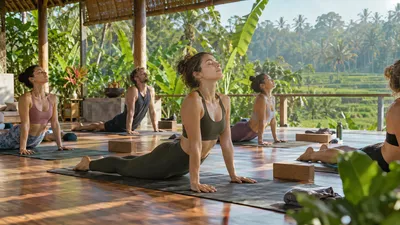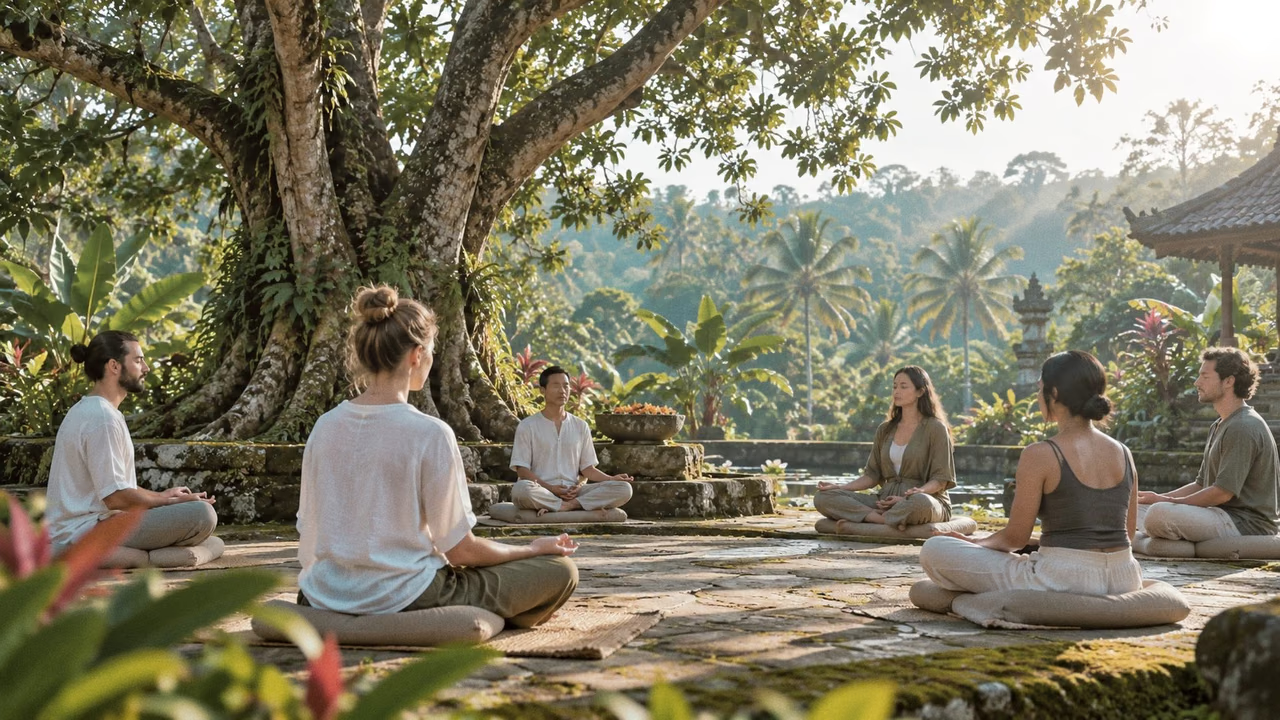
A silent retreat in Bali can mean anything from a few flexible days of quiet, yoga and meditation among rice fields to a strict 10-day Vipassana course where your phone is stored away and your day starts at 4:00 AM.
Those are very different trips.
For most solo travelers trying silence for the first time, starting at the gentler end makes more sense than treating difficulty as proof that a retreat is somehow more meaningful. Bali Silent Retreat offers the most flexibility. Samyama gives you a shorter structured program. Bali Usada steps up to a full seven-day intensive retreat. Dhamma Geha is the serious 10-day Vipassana option.
There are also hybrid programs at The Yoga Barn and Yogi’s Garden, where yoga and meditation sit alongside several days of silence.
This guide is for choosing between them, not for promising that a week without talking will fix your life.
Silent retreat vs yoga retreat: what is the difference?
These terms overlap, but they do not mean the same thing.
A yoga retreat is normally organized around yoga practice. Depending on the program, that may include physical postures, breathing practices, meditation, philosophy, workshops and wellness activities.
A silent retreat is organized around silence and contemplative practice. Meditation is usually central. Yoga may be included, but it does not have to be.
That difference becomes obvious when you compare actual Bali programs.
The Yoga Barn’s silent programs combine seated meditation with conscious movement or yin yoga. Bali Silent Retreat offers gentle movement and meditation but allows guests considerable freedom over how they spend the day. Samyama describes its program around structured silence and self-observation. Dhamma Geha goes much further, with formal Noble Silence and a tightly controlled meditation schedule.
So a silent yoga retreat is not a contradiction. It is simply a retreat where yoga and extended silence are both part of the program.
If yoga is your main reason for traveling, Wandopia also has a separate guide to the Ubud yoga retreats for solo travelers. If what you are really looking for is several days with far fewer distractions, keep reading.
A silent retreat is not Nyepi
This one is surprisingly easy to confuse when researching Bali.
Nyepi, Bali’s Day of Silence, is a Balinese Hindu holy day marking the Saka New Year. It is an island-wide religious observance, not a wellness retreat that tourists book.
A silent retreat is voluntary and takes place according to an individual retreat center’s rules. It can happen at any time of year.
For travelers planning ahead, the Indonesian government has officially set Nyepi 2027 for Monday, March 8, 2027, marking Saka New Year 1949.
Expect major disruption to normal travel around Nyepi. Exact 2027 airport and transport restrictions should be checked again closer to the date rather than assuming they will be identical to previous years.
That distinction matters because searches for phrases such as “Day of Silence in Bali” often refer to Nyepi rather than meditation retreats.
Can a silent retreat actually help?
Possibly, but this is where wellness marketing tends to sprint several kilometers ahead of the evidence.
Research on meditation retreats has reported improvements in measures such as stress, anxiety, emotional regulation and quality of life. But retreat formats, participant groups and study quality vary considerably, so those results cannot be turned into a guarantee that a particular commercial retreat in Bali will produce a specific outcome.
The U.S. National Center for Complementary and Integrative Health similarly says mindfulness and meditation may help some people with anxiety and depression symptoms, while also noting mixed findings and limitations in the research.
Yoga has reasonable evidence as a general wellness activity too, particularly around stress, sleep, balance and mental or emotional well-being. It is not a replacement for medical or psychological treatment.
So if by a “reset” you mean slowing down, practicing meditation, moving your body, sleeping, spending time away from normal routines and giving yourself room to think, a retreat can provide that environment.
If you mean treating trauma, depression, anxiety disorders or another health condition, a travel retreat should not be sold to you as treatment.
Silence is not automatically easy
Meditation is not completely risk-free either. Research into adverse effects is still limited, but negative experiences have been reported, with anxiety and low mood among them.
The more intensive the program, the more seriously I would take this.
Dhamma.org itself explicitly says Vipassana is not a substitute for medical or psychiatric treatment and does not recommend its courses for people with significant mental-health issues.
If you have a mental-health condition or are unsure how you might respond to intensive meditation and isolation, discuss it with an appropriate health professional before booking.
Which Bali silent retreat is right for you?
| Retreat | Commitment | Style | Current cost | Best fit |
|---|---|---|---|---|
| Bali Silent Retreat | Flexible | Quiet, nature, meditation, gentle movement | From Rp450,000++ room + mandatory Rp850,000++ DayPass per day | First-time retreat |
| Samyama | 3 or 5 days | Structured silence and meditation | Rp6m / 3 days; Rp10m / 5 days | Short structured retreat |
| Bali Usada Tapa Brata 1 | 7 days / 6 nights | Intensive guided meditation and Noble Silence | Confirm directly | Beginner ready for a full week |
| Dhamma Geha | 10-day course + arrival/departure | Goenka Vipassana | Donation-based | Intensive traditional practice |
| Yoga Barn / Yogi’s Garden | 4 or 7 days depending program | Silence + Zen meditation + yoga | Contact provider | Yoga-and-silence hybrid |
Prices and schedules can change. Check the provider’s current booking page before committing.
At Bali Silent Retreat, ++ means additional tax and service charges apply.
Bali Silent Retreat: the gentlest place to start
For the typical Wandopia solo traveler who is curious about silence but not looking for monastic discipline, Bali Silent Retreat is the option I would investigate first.
It is in rural Tabanan rather than central Ubud and works more like a quiet retreat environment than a fixed meditation course.
Guests can join meditation and movement programs, walk the labyrinth, explore jungle and rice-field paths, visit the hot springs, sit around the fire pit, read, write or simply do very little.
The important detail is that its silence is not absolute.
There is a designated coworking and reception area where you can talk, use Wi-Fi and recharge devices. Elsewhere, the venue asks guests to stay quiet and avoid electronics. That makes it considerably less intimidating than a course where all outside communication is prohibited.
At the time of this research, rooms started at Rp450,000++ per night (about US$25, using US$1 = Rp18,000 as a rough planning rate) for a basic single room. A mandatory Rp850,000++ DayPass (about US$47) was automatically added each day and covered meals, classes, programs and events. The retreat listed 11% government tax and 7% service charge on top. More comfortable rooms went up to Rp1.95 million++ per night (about US$108).
The minimum combination for a solo traveler therefore came to roughly Rp1.3 million++ per day (about US$72) before choosing a higher room category.
Verify these prices immediately before publication because they can change.
One practical warning: this is intentionally rustic. There is no air-conditioning or normal electrical outlet in most rooms (the two delux wooden bungalows are the only accommodations with outlets), and the property is surrounded by nature rather than sealed off from it.
That will sound wonderful to some readers and suspiciously insect-shaped to others.
Best for: first-timers, solo travelers wanting flexible quiet, people who value nature over rigid technique.
Samyama: a short but structured retreat
Samyama fills the gap between a flexible quiet stay and a week-long intensive retreat.
At the time of this research, its remaining 2026 Silent Retreat schedule included three-day programs on October 23–25 and November 20–22, followed by a five-day retreat on December 26–30.
Current prices were Rp6 million for three days (about US$333) and Rp10 million for the five-day December program (about US$556).
The retreat is explicitly described as non-residential, so do not assume accommodation is included. Samyama describes the program around structured silence, meditation, guided teaching, self-observation and inquiry.
That makes it useful for someone who wants an actual retreat structure but is not ready to give up ten days of a Bali trip.
Best for: a first or second retreat when you want structure but a shorter commitment.
Bali Usada: the local seven-day intensive option
Bali Usada deserves a place in this guide because it occupies a very different part of the spectrum.
Its core Usada Tapa Brata 1 program runs for seven days and six nights. Participants are guided through eight meditation sessions each day, with short instruction and physical relaxation around the sessions.
Participants observe Tritapa, or Noble Silence, which Bali Usada describes as refraining not only from talking but also from writing and reading during the retreat.
Meals and snacks are vegetarian.
The organization calls its method Bali Usada Health Meditation and uses the language of a “harmonious mind” and supporting the body’s natural healing process. That is the provider’s framework, not a medical claim from Wandopia.
Importantly, Bali Usada itself says its meditation does not reduce the importance of medical consultation or treatment by doctors and other health professionals.
Bali Usada has a long-standing following in Indonesia, and many participants describe its retreats as personally meaningful, particularly for calming the mind, understanding emotional patterns and developing a regular meditation practice. Some participants also report improvements in physical or mental-health conditions, but those experiences are anecdotal and should not be treated as evidence that meditation can treat disease.
My booking experience
I actually tried to book Bali Usada around May 2025 for an August birthday trip, but I could not get a place in time.
If Bali Usada is one of the main reasons for your Bali trip, plan well ahead rather than treating it as a last-minute add-on.
Also check the language carefully before booking. Bali Usada runs both Indonesian and English retreats, and not every date is offered in English.
That is an unusually important detail when you have just agreed not to speak for a week.
Best for: someone comfortable committing a full week to intensive guided meditation and interested in an established Indonesian meditation tradition.
For the wider tradition behind these practices, the separate guide Beyond the Massage: Experiencing Traditional Balinese Usada Healing covers Bali’s usada healing culture in more depth.
Dhamma Geha: the serious 10-day Vipassana option
Dhamma Geha is not a wellness resort.
It is a Vipassana meditation center in Susut, Bangli, following the S.N. Goenka tradition.
New students undertake ten full days of meditation, with arrival and departure making the total stay longer. The timetable begins with a 4:00 AM wake-up bell and includes many hours of meditation throughout the day.
Noble Silence prohibits communication with fellow students through speech, gestures or written notes, per the course code of discipline. Participants can still speak with teachers or management when necessary.
Students also commit to staying for the complete course.
The center has 52 single rooms for students and servers. During a course, men and women are completely separated, and meals are simple and vegetarian.
Courses are donation-based rather than sold at a commercial price.
At the time of research, several late-2026 courses were already filling or waitlisted. Courses remained scheduled through December, including one beginning December 23 and continuing into January 2027.
Do not choose this because it is inexpensive.
Choose it because you specifically want this form of Vipassana and understand the discipline you are signing up for.
Best for: someone deliberately seeking intensive Vipassana rather than a relaxing wellness break.
Yoga Barn and Yogi’s Garden: when yoga matters too
The Yoga Barn currently runs silent programs at Yogi’s Garden in Payangan, north of Ubud.
As of October 2026, The Yoga Barn lists Silent Zen & Yin Yoga retreats at Yogi’s Garden for October 16–19, November 22–26 and December 20–23.
Its page describes four- or seven-day formats, but the displayed date ranges do not line up consistently with those durations, so confirm the exact length directly before booking.
The defining difference is that yoga remains part of the experience. These retreats combine Zen meditation and silence with yin yoga rather than building the entire program around seated meditation.
Current pricing was not published on the page, so ask the provider rather than relying on an old article or reseller listing.
Best for: someone specifically looking for the overlap between yoga and several days of silence.
What actually happens during a silent retreat?
There is no single standard silent-retreat schedule.
That is one reason I would avoid any article promising what you will experience on “Day 3” or “Day 5.”
At Dhamma Geha, your day is structured almost hour by hour.
At Bali Usada, you work through eight guided meditation sessions.
At Samyama, the retreat revolves around structured practice and teaching.
At Bali Silent Retreat, you have considerably more control over your day.
At Yogi’s Garden, yoga and other guided practices break up the meditation periods.
The common thread is not one specific technique. It is reducing normal conversation and stimulation so that contemplative practice takes up more of your attention.
Can you use your phone?
Sometimes.
This is another question where generic advice is useless.
Bali Silent Retreat: electronics are discouraged in the silent areas, but there is a coworking/reception area for Wi-Fi, devices and conversation.
Dhamma Geha: outside communication and electronic devices are tightly restricted as part of the course.
Bali Usada: the program restricts normal communication and activities as part of Tritapa.
Samyama: structured silence is explicit, but its public retreat page did not give enough detail during this research to state a specific phone-storage policy.
Before booking, ask whether your phone is collected or simply expected to stay off, how family can contact the retreat in an emergency, whether there are any scheduled phone-access periods, whether you can leave the retreat early, and who you speak to if you are struggling physically or emotionally.
Those questions matter more than whether the booking page calls itself a “digital detox.”
How long should your first silent retreat be?
There is no scientifically established magic number.
A practical rule for travelers with little meditation experience is not to assume longer is better.
If you are simply curious, start with a day experience or a flexible quiet stay.
If you already meditate and want more structure, three days at somewhere such as Samyama is a meaningful commitment without consuming most of a Bali trip.
A seven-day Bali Usada program is a much bigger step.
A 10-day Vipassana course should be a deliberate choice rather than something you bolt onto your vacation because Instagram made silence look photogenic.
The goal is to find the level you actually want, not win the unofficial Bali Olympics of inner peace.
How much do silent retreats in Bali cost?
The range is enormous because you are comparing fundamentally different products.
At one end, Dhamma Geha operates on donations.
At the time of research, Bali Silent Retreat started at roughly Rp1.3 million++ per day when its cheapest solo room and mandatory DayPass were combined.
Samyama currently listed Rp6 million for three days or Rp10 million for five days, but it is non-residential.
Yoga Barn/Yogi’s Garden pricing varies by retreat.
Bali Usada’s current public program pages did not give a sufficiently clear price to quote confidently, so check directly with them rather than copying a number from a third-party site.
Using the same rough planning rate, the published paid options span roughly US$72 per day at the quiet end to about US$556 for the five-day Samyama program.
Also budget for accommodation before or after a non-residential retreat, transport, meals that are not included, optional treatments, and possibly an extra night nearby before an early start.
For solo travelers, that extra night nearby is especially sensible. Arriving late after fighting Bali traffic is a poor opening exercise in equanimity.
What should you check before booking?
Look past the dreamy photographs.
Ask how many hours a day you will actually meditate, whether participation is optional, what “silence” means at that particular retreat, whether accommodation and meals are included, whether you can leave early and how emergencies are handled.
For a solo traveler, also confirm the exact location and transport plan. Some retreats are deliberately far from Ubud’s center.
Check the accommodation too. “Retreat” can mean anything from a private bungalow to a simple room with shared bathrooms.
And if the program makes specific promises about curing trauma, illness, anxiety or another health problem, consider that a reason to investigate harder, not a reason to book faster.
Not ready for several days of silence?
You do not have to jump directly from normal vacation mode to Noble Silence.
If several days of silence sounds like too much commitment, a one-day Ubud wellness experience can give you yoga, meditation and time away from a normal sightseeing schedule without giving up several days of your trip.
A Day Retreat In Ubud is a current example. At the time of writing it combined yoga and meditation, a massage, lunch and a purification ritual at Mengening. It is a wellness alternative to a silent retreat, not a test of whether you can handle Noble Silence.
Check current Ubud wellness-day availability on Viator
Inclusions, prices and availability for that day retreat change, so treat the current listing as the source of truth rather than anything quoted here.
If you are curious about the purification part, What Is Melukat in Bali? Meaning and Visitor Etiquette explains how the ritual works before you book.
How to fit a retreat into a normal Bali trip
For most solo travelers, I would not land at DPS and go directly into several days of silence.
Give yourself at least one night to recover from the flight, sort out your phone, withdraw or exchange money, and arrive at the retreat without running on airport adrenaline.
Likewise, do not necessarily schedule a long transfer or international flight immediately after an intensive retreat.
A slower day afterward gives you room to eat properly, sleep and adjust to normal conversation again.
If the retreat is around Ubud, Bangli, Kintamani or Tabanan, you can then build the rest of your itinerary around central Bali rather than bouncing across the island.
And if you are visiting around Nyepi on March 8, 2027, treat Nyepi itself as a separate travel-planning issue. It is not an extra free retreat day.
Which one makes the most sense for a first retreat?
For a first-time solo traveler who says:
“I’m tired, I want quiet, some meditation and nature, but I don’t know whether I can handle days of strict silence.”
Bali Silent Retreat is the most approachable option to investigate first.
If you specifically want a structured meditation program but do not want to commit a week, look at Samyama.
If you want a serious week-long Indonesian meditation program, look at Bali Usada and make sure the dates are offered in a language you understand.
If what you actually want is traditional 10-day Vipassana, Dhamma Geha is the clear choice.
And if yoga is central to what you are looking for, the Yogi’s Garden / Yoga Barn hybrid makes more sense than choosing a meditation retreat merely because somebody put the word “wellness” in its title.
The right retreat is not the strictest or most expensive one.
It is the one whose rules you understand before you arrive.