If you search for traditional healing in Bali, it does not take long before things get blurry.
You will find balians, herbal remedies, meditation centers, chakra treatments, Balinese massage, purification ceremonies and enough “ancient wisdom” to fill several retreat brochures.
Usada is more specific than that.
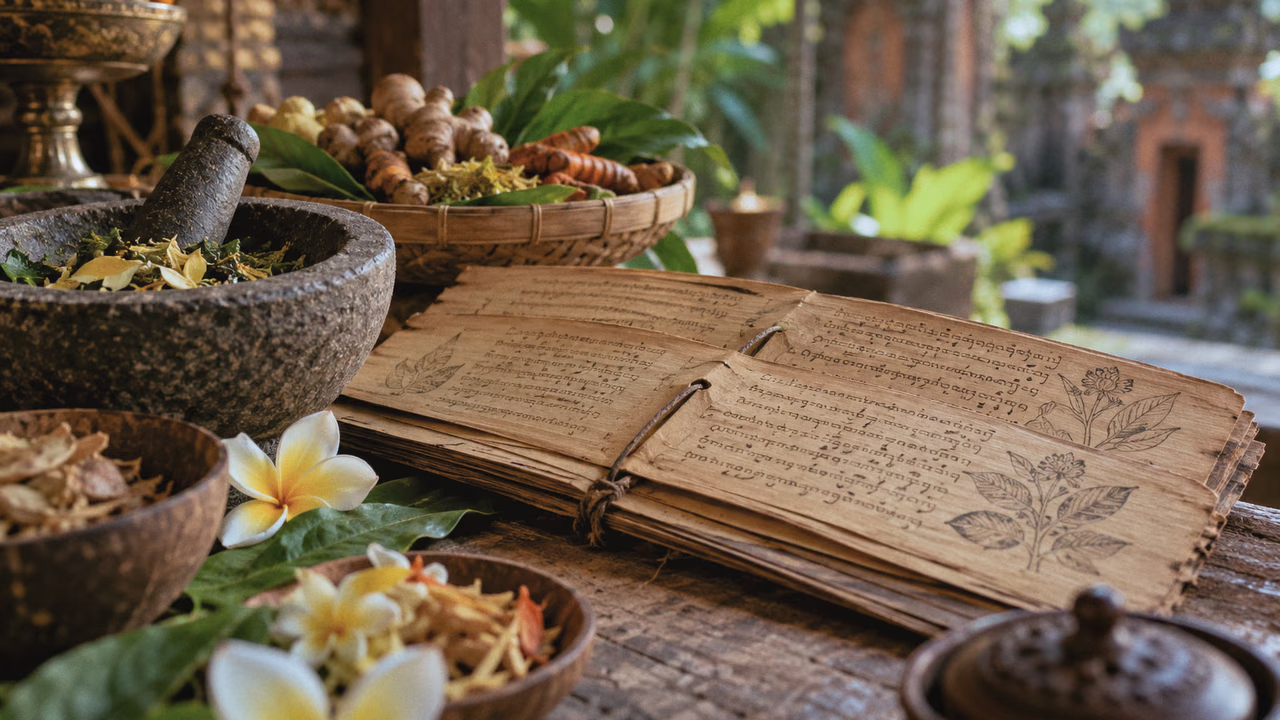
It refers to Balinese traditional health knowledge and practice, some of which has been preserved in lontar, the palm-leaf manuscripts used to record everything from religion and philosophy to medicine.
That does not make Usada one standardized treatment, and it certainly does not mean every service marketed as “Balinese healing” is Usada.
The more interesting story is how this traditional knowledge developed, how it is still used today, and where the line starts getting fuzzy between Balinese medicine and Bali’s modern wellness industry.
So, what exactly is Usada?
Usada, sometimes written Usadha, is a term used for traditional Balinese medicine and health knowledge.
Some of this knowledge was written down in medical lontar manuscripts. Other knowledge has been passed between teachers, families and practitioners.
Those traditions can involve medicinal plants, preparations made from natural ingredients, manual treatments and other forms of traditional care. Depending on the practitioner and tradition, religious or spiritual ideas can also be part of how illness and wellbeing are understood.
Bali’s own traditional-health regulations describe the system broadly. They recognize knowledge inherited through generations as well as practices recorded in Lontar Usada or learned through training.
So Usada is much wider than the “energy healing” label that appears surprisingly often online.
And there is another important point: there is no single Usada treatment.
Different manuscripts deal with different subjects, and different practitioners may work in very different ways.
The lontar connection
Lontar are traditional palm-leaf manuscripts, usually written by inscribing characters into prepared leaves.
There are many kinds of lontar in Bali. Some concern religion, philosophy, calendars or rituals. Others contain traditional medical knowledge.
These medical texts are generally referred to as Lontar Usada.
One of the better-known examples is Taru Pramana, which deals extensively with plants and their traditional medicinal uses.
It is tempting to imagine a giant Balinese medical encyclopedia containing one authoritative answer to every illness, but that is not really how this works.
There are different Usada manuscripts, different copies and different traditions of interpretation.
There is even an interesting problem buried in the manuscripts themselves.
Research from Udayana University comparing copies of Usada texts has found transcription and copying errors, including mistakes that could affect the identification of medicinal ingredients.
That makes the lontar fascinating historical and cultural sources.
It also makes them a bad place for ordinary readers to start copying herbal recipes from.
So you will not find a “five Usada remedies to try in your hotel room” section here.
Probably for the best.
Who is a balian?
The word balian is commonly used for a Balinese traditional healer.
But, again, the tidy version you often see online is a little too tidy.
Not every balian necessarily practices exactly the same kind of healing or draws on the same Usada texts. Knowledge may come through study, a teacher, family tradition, religious practice or a combination of different sources.
In Bali’s current traditional-health regulations, you will also encounter the term pengusada for someone providing certain forms of empirical Balinese traditional-health care.
That distinction is useful because it reminds us that “balian” is not the name of one standardized profession with one standardized treatment menu.
This is also why I would be wary of articles promising a list of the “10 best balians in Bali.”
A traditional practitioner is not quite the same thing as choosing between massage spas on Google Maps.
Where do mind and spirituality fit into Usada?
This is probably the part that creates the most confusion.
Traditional Balinese ideas about health can include physical, mental, social and spiritual wellbeing rather than treating each of those as completely separate boxes.
Some practitioners may also understand illness through concepts that do not have a direct equivalent in modern medicine.
That does not mean we have to choose between two extremes.
You do not have to dismiss those ideas because they are traditional.
You also do not have to treat every traditional explanation as a scientifically demonstrated medical mechanism.
They are two different questions.
Understanding how a culture explains illness is interesting in its own right.
Whether a particular treatment has been clinically shown to work for a particular condition is another matter entirely.
That distinction becomes particularly important once Usada enters Bali’s tourism and wellness world.
Usada is not automatically a spa treatment
This is where things get a little foggy.
Balinese spas may use local herbs, oils, massage techniques, boreh body preparations and other treatments inspired by Indonesian or Balinese traditions.
Some of those practices can have genuine historical roots.
But putting ginger on someone and playing gamelan music in the background does not automatically turn a spa treatment into Usada.
The same applies to Reiki, chakra balancing, sound healing, crystal treatments, “energy clearing” and other services commonly offered around Bali.
Those practices may be meaningful to the people who offer or enjoy them.
They just should not automatically be bundled together under “traditional Balinese healing.”
Modern Bali has a huge wellness industry, and different traditions have mixed together over time.
Usada is part of that landscape, but it is not a synonym for the whole thing.
Usada is not Melukat either
Melukat sometimes gets thrown into the same wellness basket.
It deserves its own basket.
Melukat is a Balinese Hindu purification practice, usually involving holy water, prayer and religious ritual.
That is different from Usada as a traditional-health tradition.
The two worlds can overlap because religion, community and health are not always neatly separated in Balinese life. A practitioner may incorporate religious elements into what they do.
But a Melukat ceremony should not simply be marketed as a medical treatment.
And if what interests you is the religious and cultural side of purification, I would read about Melukat separately rather than treating it as the next stop on a Bali “healing checklist.”
Then what is Bali Usada Health Meditation?
This one confused me at first too.
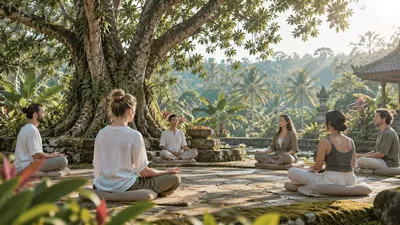
Bali Usada Health Meditation is the name of a specific modern meditation organization founded by Merta Ada in 1993.
It is not another name for the entire Usada tradition.
According to the organization, its meditation system draws from knowledge and traditions from Bali, India and China, together with Merta Ada’s experience as a healer and meditation teacher.
Its teaching includes concentration, mindfulness, loving-kindness and other meditation practices.
The organization also says Merta Ada developed his approach partly through studying old Balinese lontar and traditional healing knowledge.
That makes Bali Usada genuinely interesting in this story.
It shows how traditional ideas can continue evolving rather than remaining frozen in a museum cabinet.
But it is better understood as a modern system influenced by several traditions, not as the definition of traditional Usada itself.
Bali Usada also makes broad health claims on its website. That does not necessarily mean those outcomes have been clinically demonstrated, so I would separate the organization’s claims from what the evidence actually supports.
You can still find the meditation practice interesting without needing to settle that question first.
Does Usada actually work?
There is no very useful yes-or-no answer to that question because Usada is not one treatment.
A plant preparation, massage technique, meditation practice and spiritual ritual cannot all be evaluated as though they were the same thing.
Some plants traditionally used in medicine may contain biologically active compounds worth studying.
Some practices may help people relax, feel supported or make sense of an illness within their own cultural framework.
Other medical claims may have little or insufficient clinical evidence behind them.
The World Health Organization takes a similarly nuanced position toward traditional medicine generally. It supports research and appropriate integration while emphasizing evidence, safety, practitioner competence and regulation.
That seems much more useful than either “traditional medicine is nonsense” or “people have done it for centuries, therefore it must work.”
Reality is usually less convenient than either slogan.
Should you visit a balian or pengusada?
Maybe.
But not because visiting a healer is something every traveler needs to tick off to experience the “real Bali.”
Traditional healing exists first as part of Balinese life, not as an attraction created for visitors.
If you are simply curious about Usada, reading about the tradition may be enough.
If you genuinely want to consult a traditional practitioner, then I would treat the decision with a little more care than booking a massage.
Find out who the practitioner is and what kind of treatment they provide.
Ask what will happen during the consultation.
If physical treatment is involved, know what kind of contact to expect.
If herbs or preparations are involved, ask what they contain.
And if someone is providing professional traditional-health services, it is reasonable to ask about their training or registration.
Bali’s 2019 regulation says a pengusada providing empirical Balinese traditional-health services must hold an STPT, a registration certificate for traditional health practitioners.
The same regulation also says practitioners should work within their competence and refer someone elsewhere when the care they need falls outside it.
That part I particularly like.
Traditional and modern medicine do not need to behave like rival football teams.
A few things would make me walk away
Someone promising relaxation or saying a treatment has traditionally been used for a particular problem is one thing.
A guaranteed cure is something else.
I would be cautious if a practitioner tells you to stop prescribed medication, discourages you from seeing a doctor for a serious condition or claims they can definitely cure illnesses that require proper medical care.
The same applies if you feel pressured into physical contact, buying expensive remedies or participating in rituals you are uncomfortable with.
Being respectful of another culture does not mean abandoning your own boundaries.
You can say no.
Be especially sensible about herbal remedies
Medicinal plants are one of the genuinely interesting parts of the Usada tradition.
They are also one reason not to treat “natural” as another word for harmless.
Plants contain chemicals too.
Herbal preparations can cause side effects, interact with medication or simply be inappropriate for a particular person.
That becomes more important if you have a medical condition, take prescription medication, are pregnant or do not actually know what is in the preparation you have been given.
I would be much more comfortable trying a massage than swallowing an unidentified herbal mixture because somebody told me it was traditional.
Curiosity is useful.
So is knowing when to ask another question.
Solo travelers do not need a special mystical safety manual
The normal rules still work.
Know where you are going.
Arrange your own transport if the location is unfamiliar.
Tell someone where you will be if you are heading somewhere remote.
Do not carry unnecessary valuables.
And pay attention to how the practitioner communicates with you.
A traditional setting can sometimes make visitors reluctant to speak up because they are worried about being rude.
You are still allowed to ask what is happening.
You are still allowed to decline something.
And you are definitely allowed to leave if you feel uncomfortable.
A quick health note
Usada and other traditional-health practices can be interesting parts of Balinese culture and contemporary life, but this article is not medical advice. If you have a serious health problem, need a diagnosis or are considering taking an unfamiliar herbal preparation, appropriate medical care still matters.